Prefetch#
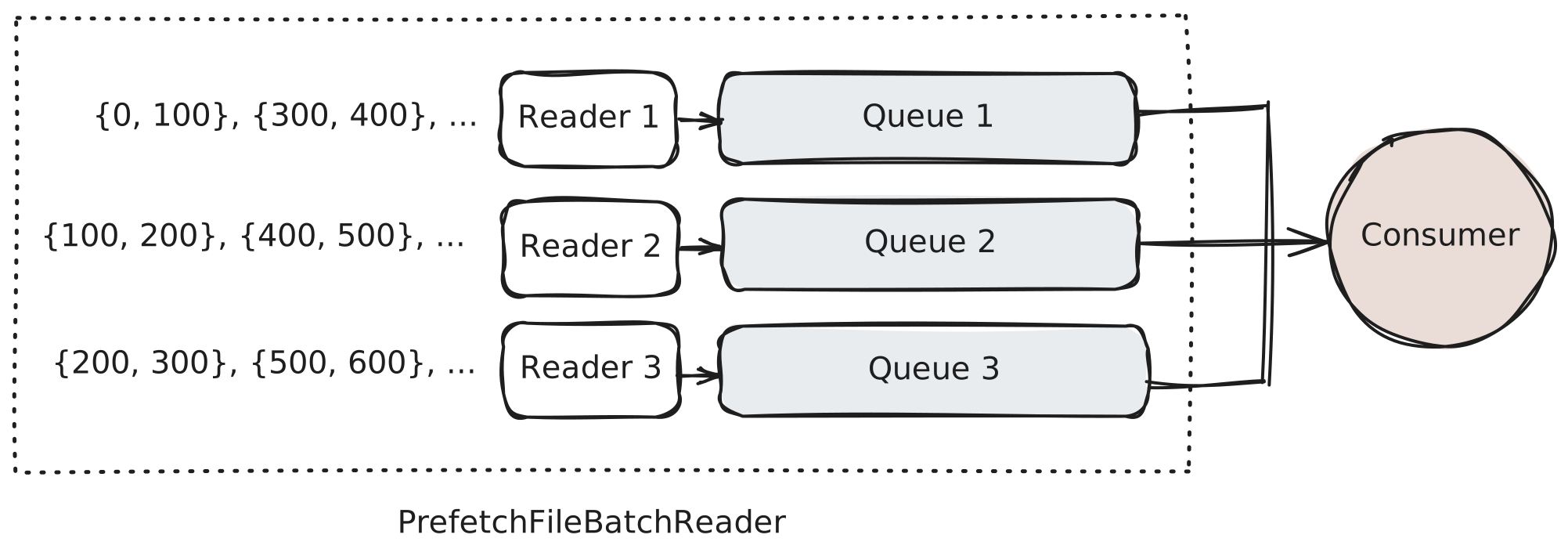
In Paimon C++, we use a multi-producer, single-consumer model to optimize file reading. The core idea is to split a file into row-based read ranges and assign them to multiple reader threads (producers). Each reader thread owns an independent result queue that holds its processed RecordBatches. In the main reader thread (the consumer), we sort the heads of all queues by the read range’s starting row and select the RecordBatch with the smallest starting row to ensure globally ordered results.
Read Range Splitting Strategy#
Designing an efficient ReadRange splitting strategy requires balancing two key objectives:
Minimize read amplification: Ensure the data fetched from storage is used effectively, avoiding unnecessary I/O overhead.
Reduce ReadRange span: Ideally, the size of a ReadRange should match a single read batch size to enable fine-grained parallel control.
Below we detail how these strategies are applied to Parquet and ORC.
Parquet#
Parquet files are organized into RowGroups and Pages. Since C++ Parquet does not support row-level seeking, prefetching can only be done at the RowGroup level. This naturally avoids read amplification, but introduces a new challenge: if a file contains only a small number of RowGroups, parallelism is severely limited. Therefore, we recommend users reduce RowGroup size when writing Parquet files to increase opportunities for parallel processing.
Another critical difference is the read behavior compared to ORC. ORC strictly returns RecordBatches aligned to Stripe boundaries, whereas C++ Parquet may return a RecordBatch containing data from multiple RowGroups. This can lead to output order confusion during parallel reads. We modified C++ Parquet internals to return results strictly aligned to RowGroup boundaries, matching ORC’s behavior. With this change, parallel reading no longer requires complex seek operations, improving overall read efficiency.
ORC#
ORC files are organized into Stripes. Paimon C++ generates row ranges from Stripe metadata, the selected columns, and the configured natural read size. Prefetch is enabled when the estimated compressed size of the selected columns exceeds the configured threshold; otherwise the reader uses the normal single-reader path.
Warmup#
Prefetching parallelizes the reads inside one file. When the data files of a
split are read one after another, warmup also overlaps the files with each
other: while one file is being consumed, the reader already starts the first
read of the next one, instead of waiting until the current file reaches its
end. Warmup looks one file ahead of the file being read, and merge-on-read with
the default loser-tree sort engine additionally warms the first file of
every sorted run before merging. It applies to append-table reads and append
compaction as well, but does not cross split boundaries.
How far the next file is prepared is set with
ReadContextBuilder::SetWarmupLevel(). Append compaction builds its own read
context and always uses the default level.
WarmupLevel::NONE: do not warm up.WarmupLevel::RAW(default): fetch the next file’s raw bytes through the read-ahead cache without decoding them. It has no effect when the read-ahead cache is disabled withReadContextBuilder::SetReadAheadCacheEnabled().WarmupLevel::DECODED: also start decoding the next file, which hides the most latency but uses the most memory.
Warmup goes through the prefetch reader, so it only applies to Parquet and ORC
files that are actually read with prefetching, and enabling prefetch alone does
not guarantee that. With the adaptive strategy, a file whose first read range
holds more batches than one prefetch queue can buffer is read without
prefetching, and so without warmup; the prefetch.adaptive-disabled-count
metric counts how often this happens. Append compaction uses a prefetch queue
of three batches, so it only warms files whose first read range spans no more
than three full batches, such as files with small row groups.
WarmupLevel::RAW issues its fetches from the reading thread through the
file system’s asynchronous read, so it only overlaps I/O when that read is
really asynchronous. The local file system serves it synchronously, so there
RAW warmup reads the next file on the reading thread before the current
batch is returned, adding latency instead of hiding it. On such file systems,
prefer WarmupLevel::DECODED, which fetches on the background decode thread,
or WarmupLevel::NONE.
Warmup preserves the returned rows and their order, but it costs memory: under
WarmupLevel::RAW the next file may hold up to the read-ahead cache’s
pre-buffer limit (256 MiB by default, see CacheConfig::SetPreBufferLimit())
on top of the file being read. It may also fetch data from a file that the
reader never consumes: a read that stops early, for example because of a LIMIT,
may already have warmed the next file, and closing it waits for that file’s
in-flight fetches.