Primary Key Table#
If you define a table with primary key, you can insert, update or delete records in the table.
Primary keys consist of a set of columns that contain unique values for each record. Paimon enforces data ordering by sorting the primary key within each bucket, allowing users to achieve high performance by applying filtering conditions on the primary key.
Bucket#
Unpartitioned tables, or partitions in partitioned tables, are sub-divided into buckets, to provide extra structure to the data that may be used for more efficient querying.
Each bucket directory contains an LSM tree and its changelog files.
Note
Changelog is not supported yet for Paimon C++ primary key table write.
The range for a bucket is determined by the hash value of one or more columns in the records. Users can specify bucketing columns by providing the bucket-key option. If no bucket-key option is specified, the primary key (if defined) or the complete record will be used as the bucket key.
A bucket is the smallest storage unit for reads and writes, so the number of buckets limits the maximum processing parallelism. This number should not be too big, though, as it will result in lots of small files and low read performance. In general, the recommended data size in each bucket is about 200MB - 1GB.
Also, see rescale bucket if you want to adjust the number of buckets after a table is created.
LSM Trees#
Paimon adopts the LSM tree (log-structured merge-tree) as the data structure for file storage. This documentation briefly introduces the concepts about LSM trees.
Sorted Runs#
LSM tree organizes files into several sorted runs. A sorted run consists of one or multiple data files and each data file belongs to exactly one sorted run.
Records within a data file are sorted by their primary keys. Within a sorted run, ranges of primary keys of data files never overlap.
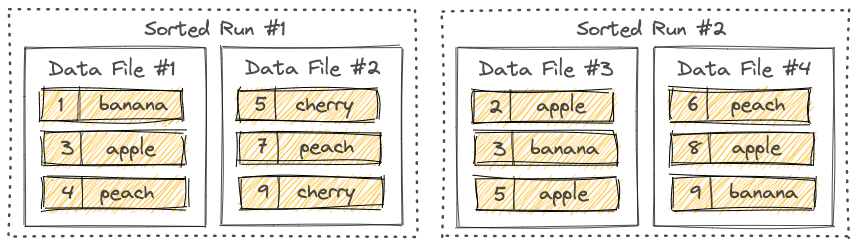
As you can see, different sorted runs may have overlapped primary key ranges, and may even contain the same primary key. When querying the LSM tree, all sorted runs must be combined and all records with the same primary key must be merged according to the user-specified merge engine and the timestamp of each record.
New records written into the LSM tree will be first buffered in memory. When the memory buffer is full, all records in memory will be sorted and flushed to disk. A new sorted run is now created.
Merge Engines#
When Paimon sink receives two or more records with the same primary key, it
merges them into one record to keep the primary key unique. The
merge-engine table option decides how. Paimon C++ supports deduplicate
(the default, which keeps the last record), partial-update, first-row
and aggregation.
Aggregation#
The aggregation merge engine aggregates each value field across the records
sharing a primary key, using the function configured for that field. Fields
without a configured function fall back to
fields.default-aggregate-function, and then to last_non_null_value.
merge-engine = aggregation
fields.<field-name>.aggregate-function = <function>
fields.default-aggregate-function = <function>
fields.<field-name>.ignore-retract = true
The available functions are sum, product, min, max,
first_value, last_value, first_non_null_value,
last_non_null_value, bool_and, bool_or, listagg, collect,
merge_map, nested_update, hll_sketch and theta_sketch. Each one
accepts only the field types it is defined for. An unknown function, or a
function configured on an unsupported field type, is rejected when aggregation
logic is initialized. Read paths that bypass aggregation may skip this
validation.
Not every function can process a retraction, that is a record whose row kind is
DELETE or UPDATE_BEFORE. A function that cannot returns an error, unless
fields.<field-name>.ignore-retract is set, which drops the retraction
instead.
product#
Multiplies the values of a field. It accepts TINYINT, SMALLINT,
INT, BIGINT, FLOAT, DOUBLE and DECIMAL, and it supports
retraction by dividing the accumulated value.
merge-engine = aggregation
fields.price.aggregate-function = product
Null values are skipped, so aggregating a null into a field leaves the field unchanged, and the first non-null value seeds the product. Retracting into a field that is still null leaves it null rather than producing a reciprocal.
Integer arithmetic is exact. A product or a quotient outside the range of the
field type, a division by zero, and dividing the smallest value of the type by
-1 all fail with an error instead of wrapping around. An integer quotient
truncates towards zero, so retracting 3 from 10 yields 3.
FLOAT and DOUBLE follow IEEE 754 instead of reporting an error.
Retracting a zero from a finite non-zero value yields an infinity carrying the
sign of both operands, and retracting a zero from a zero yields NaN.
DECIMAL has two boundary behaviors worth knowing, both matching Paimon
Java:
The product and the quotient are rounded half up to the scale of the field. A result that no longer fits the precision of the field aggregates to
NULLrather than failing, so aDECIMAL(4, 2)field holding99.99 * 99.99becomesNULL.Retraction only accepts a quotient with a finite decimal expansion, and returns an error otherwise.
1.00 / 8.00is accepted and rounds to0.13, while2.00 / 3.00is rejected.