Row Format Specification
The Row format (.row) stores complete rows in compressed blocks and includes offsets for
locating rows within each decompressed block. Use this reference for the file layout, value
encoding, and row-selection behavior.
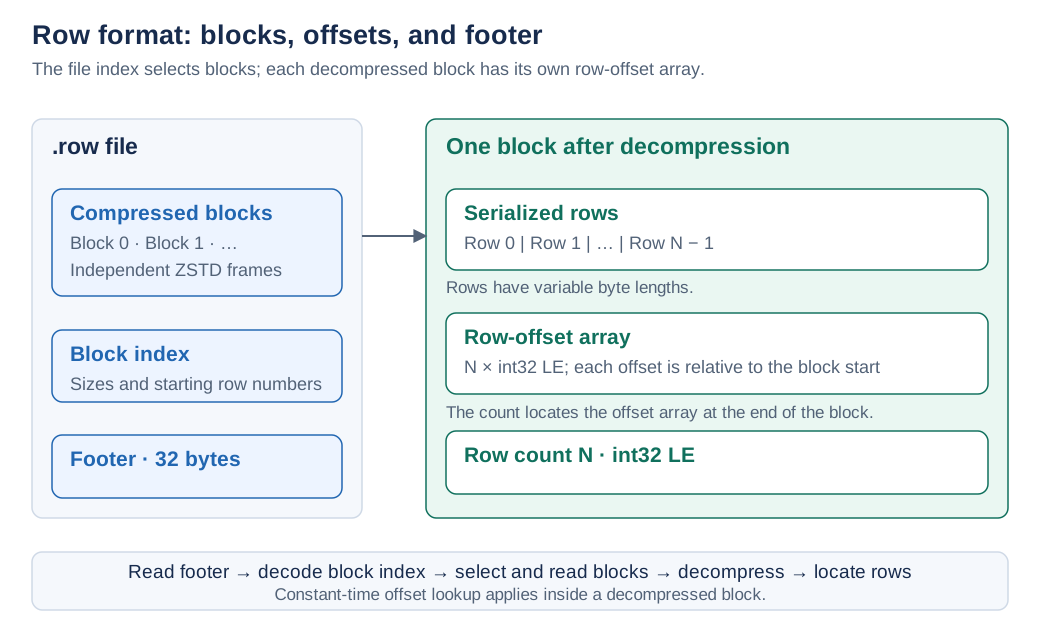
The offset lookup within a decompressed block is O(1). Reading a row also requires selecting, reading, and decompressing its block, so end-to-end lookup is not O(1).
File Layout
A .row file contains independently compressed data blocks, an encoded block index, and a
fixed-size footer. The footer locates the index; the index describes the data blocks.
| Section | Role |
|---|---|
| Data blocks | Store rows with per-row offsets inside each compressed block. |
| Block index | Store block sizes and starting row numbers. |
| Footer | Locate the block index and identify the format. |
Data Block
Each data block is independently compressed with ZSTD. The compression level is controlled by
file.compression.zstd-level and defaults to 1. The uncompressed content has the following layout:
+-----------------------------------------------------------+
| row_0_bytes | row_1_bytes | ... | row_N_bytes             |
+-----------------------------------------------------------+
| offset[0] (int32 LE) | offset[1] | ... | offset[N]       |
+-----------------------------------------------------------+
| row_count (int32 LE)                                      |
+-----------------------------------------------------------+
- Row data region: Each row is serialized sequentially using the compact row format (see below).
- Offset array: An array of int32 little-endian values, one per row, storing the byte offset of each row within the uncompressed block.
- Row count: A single int32 little-endian value at the very end of the block, storing the number of rows in this block.
A new block is flushed when the estimated uncompressed size reaches the configured block size threshold (default 64 KB, configurable via file.block-size).
Row Serialization Format
Each row is serialized as:
+-----------------------------------------------+
| null_bitmap | field_0 | field_1 | ... | field_N |
+-----------------------------------------------+
Null bitmap: ceil(arity / 8) bytes. Bit i is set (1) if field i is null. The bit position is byte[i/8] & (1 << (i%8)). Non-null fields are serialized in order; null fields occupy no space beyond the bitmap bit.
Primitive Type Encoding
All multi-byte primitives use little-endian byte order.
| Paimon Type | Encoding |
|---|---|
| BOOLEAN | 1 byte: 0 = false, 1 = true |
| TINYINT | 1 byte signed |
| SMALLINT | 2 bytes int16 LE |
| INT / DATE / TIME | 4 bytes int32 LE |
| BIGINT | 8 bytes int64 LE |
| FLOAT | 4 bytes IEEE 754 LE |
| DOUBLE | 8 bytes IEEE 754 LE |
| CHAR / VARCHAR | varint(length) + UTF-8 bytes |
| BINARY / VARBINARY | varint(length) + raw bytes |
| DECIMAL(P, S) where P <= 18 | 8 bytes int64 LE (unscaled long) |
| DECIMAL(P, S) where P > 18 | varint(length) + unscaled bytes (big-endian two's complement) |
| TIMESTAMP(P) where P <= 3 | 8 bytes int64 LE (epoch millis) |
| TIMESTAMP(P) where P > 3 | 8 bytes int64 LE (epoch millis) + varint(nanoOfMillisecond) |
| VARIANT | varint(len1) + value bytes + varint(len2) + metadata bytes |
Varint Encoding
Variable-length integer encoding (unsigned LEB128):
- Each byte uses 7 bits for data and 1 bit (MSB) as continuation flag.
- If MSB = 1, more bytes follow. If MSB = 0, this is the last byte.
- Maximum 5 bytes for int32 values.
Complex Type Encoding
ARRAY:
varint(size) | null_bitmap[ceil(size/8) bytes] | element_0 | element_1 | ... | element_N
Null bitmap uses the same bit layout as row nulls. Non-null elements are serialized in order using the element type's encoding.
MAP:
A map is serialized as two arrays (keys array followed by values array):
[keys array] [values array]
Each array follows the ARRAY encoding above (varint size + null bitmap + elements). Both keys and values support null entries.
ROW (nested):
Nested rows use the same format as top-level rows:
null_bitmap[ceil(arity/8) bytes] | field_0 | field_1 | ... | field_N
Block Index
The block index stores metadata for all blocks. Its ordered row-start array can be searched to locate a row; the current reader scans the index to select blocks that intersect the requested row ranges.
+--------------------------------------------------------------------+
| varint(len_0) | encoded_block_compressed_sizes                      |
| varint(len_1) | encoded_block_uncompressed_sizes                    |
| varint(len_2) | encoded_block_row_starts                            |
+--------------------------------------------------------------------+
Each of the three arrays is encoded using Delta + ZigZag + Varint compression:
- Compute deltas between consecutive values
- ZigZag encode each delta (maps signed to unsigned)
- Varint encode each ZigZag value
This is highly efficient for monotonically increasing sequences (row starts) and similar-valued sequences (sizes).
The arrays are:
- blockCompressedSizes: Compressed size of each block. Block offsets are derived by prefix sum (first block starts at file position 0).
- blockUncompressedSizes: Uncompressed size of each block (needed to allocate decompression buffer)
- blockRowStarts: Cumulative row count at the start of each block (for binary search)
A well-formed index satisfies all of the following, and a reader rejects a file that does not:
- The three arrays have the same length, and that length equals the footer's
blockCount. blockCompressedSizes[]sums to exactlyindexOffset. Blocks are written contiguously from position 0 and the index follows the last one, so any other sum means the two disagree about where the blocks end.- No size is negative. The sum alone does not imply this: two sizes can cancel.
blockRowStarts[0]is 0, and each later start is strictly greater than the one before it. A reader turns consecutive starts into a block's row range, so a first start past 0 leaves the rows before it unreachable and a repeated start gives a block an empty range.blockRowStarts[last]is less than the footer'stotalRowCount, so the last block holds at least one row.- An empty index has
blockCount0 andtotalRowCount0.
Footer
The footer occupies the last 32 bytes of the file. Offsets below are relative to the start of the footer. All multi-byte numeric fields are little-endian.
| Offset | Field | Size | Meaning |
|---|---|---|---|
0 | totalRowCount | 8 bytes | Total rows in the file. |
8 | blockCount | 4 bytes | Number of data blocks. |
12 | indexOffset | 8 bytes | Absolute file offset of the block index. |
20 | indexLength | 4 bytes | Block-index length in bytes. |
24 | version | 1 byte | Format version, currently 1. |
25 | reserved | 3 bytes | Reserved bytes, written as zero. |
28 | magic | 4 bytes | Integer 0x524F5753, serialized as bytes 53 57 4F 52. |
The magic is a little-endian integer. Do not write the ASCII byte sequence ROWS in its place.
Row Number Lookup Algorithm
To read a row by its zero-based row number within the file:
- Read Footer: Seek to file end - 32 bytes, read the 32-byte footer. Validate magic number.
- Read Block Index: Seek to
indexOffset, readindexLengthbytes, decode the three arrays. Compute block offsets by prefix sum ofblockCompressedSizes[]. - Check Consistency: Verify the block index against the footer, as described under Block Index. A reader that bounds its block loop by one of the two — the footer's
blockCountor the index array length — must reject a file where they disagree rather than silently reading fewer blocks. - Select Block: Find block
bwhereblockRowStarts[b] <= rowNum < blockEnd. For the last block,blockEndistotalRowCount; otherwise it isblockRowStarts[b + 1]. - Read Block: Seek to
blockOffset(b), readblockCompressedSizes[b]bytes. - Decompress: ZSTD decompress into a buffer of size
blockUncompressedSizes[b]. - Locate Row: Compute
localIdx = rowNum - blockRowStarts[b]. Readoffsets[localIdx]from the offset array at the end of the decompressed block. - Deserialize: Read the row starting at the computed offset using the row serialization format.
Projection
Column projection is applied after full row deserialization. Since the compact row format serializes fields sequentially without per-field offset metadata, individual fields cannot be skipped during deserialization. After the complete row is deserialized, a projection mapping selects the requested columns.
Selection (Deletion Vectors)
Row selection via RoaringBitmap32 enables efficient filtering:
- For each block, check if the selection bitmap intersects with
[blockRowStart, blockRowEnd). - If there is no intersection, skip decompression and row decoding for that block.
- If there is an intersection, decompress the block and only deserialize the selected rows using their local indices.
Vectored reads can combine nearby byte ranges into one I/O request. Such a request can include bytes from an unselected block between selected blocks; those extra bytes are not decompressed.
Configuration
| Option | Default | Description |
|---|---|---|
file.block-size | 64 KB | Uncompressed block size threshold. Larger blocks improve compression ratio but increase read amplification for point lookups. |
file.compression.zstd-level | 1 | ZSTD compression level used when writing blocks. |